Beyond the Built Environment: Ecological Knowledge, Just Transitions and Resistance in Antakya
DPU/ASF–UK Fellow Bonnie Greer examines how recognising knowledge and relationships with land can reshape reconstruction and challenge displacement.

By Bonnie Greer
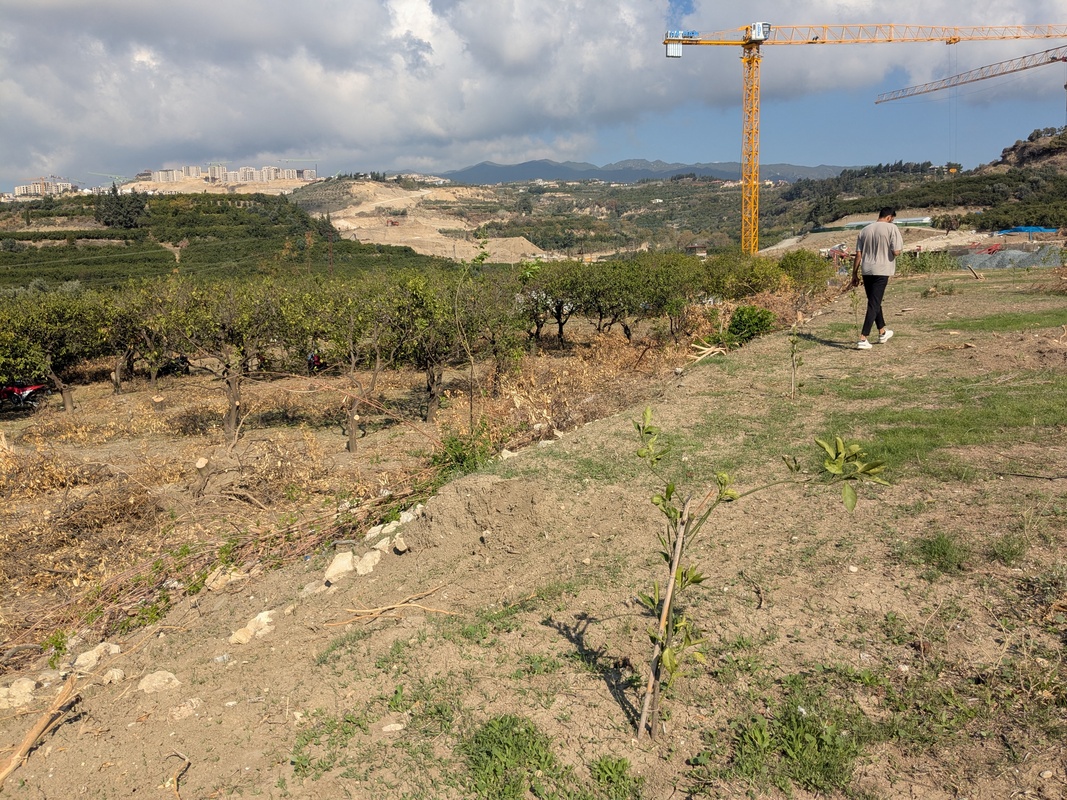
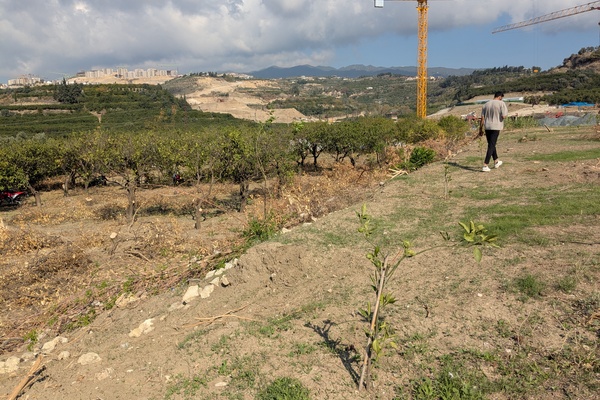
In Samandağ, local residents and activists replanted mandarin trees uprooted by the government to make way for post-earthquake mass housing, as part of their mobilisation against the plans. (Credits: Francesco Pasta)
Are sustainable development frameworks equipped to centre local voices and knowledge systems? If so, could this change the outcomes of development projects and help reduce displacement?
Decolonial and post-development academics, like Arturo Escobar, argue that large-scale sustainable development frameworks can re-establish colonial power dynamics and undermine the cultural fabric that is the backbone of local communities’ resilience and sustainability (Escobar, 2018). As a fellow with Architecture Sans Frontières UK (ASF–UK), I approach my dissertation through a pluriversal lens (the Zapatista idea of a world where many worlds fit), exploring how Traditional Ecological Knowledge can inform research and diagnostic practices in Just Urban Transitions (Dávila, Langlois and Leitão, 2023).
Just Urban Transitions (JUT) is a new framework for assessing how just an urban environment is, treating a city as three interconnected couplings (social, ecological and technological) and asking how distributive, procedural, inclusive and restorative justice play out in each, yet neither of its two foundational publications mentions displacement (Hughes and Hoffmann, 2020; Sun et al., 2025). Traditional Ecological Knowledge (TEK) is the knowledge, practice and belief handed down through generations about how living beings, humans included, relate to their environment (Berkes, 1999, p.7). Although most commonly discussed in Indigenous contexts, some scholarship also applies the concept to other communities holding intergenerational, place-based ecological knowledge (Martin et al., 2010).
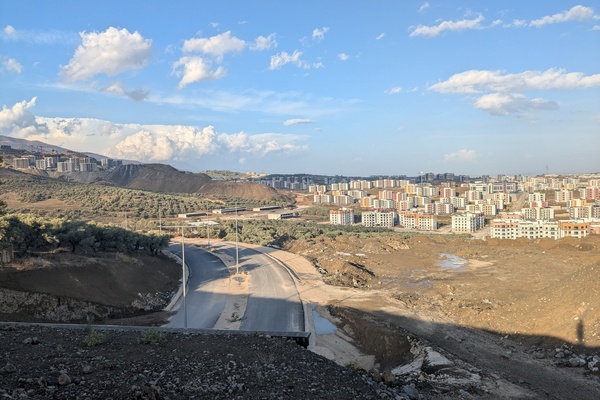
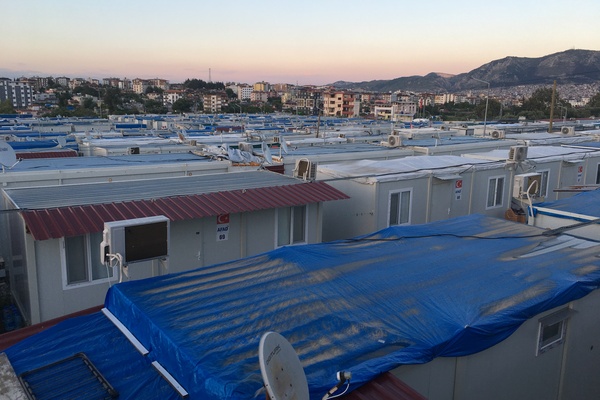
My case study is ASF–UK’s work in Türkiye since the 2023 earthquakes, where the organisation collaborates with local communities experiencing a top-down reconstruction process that follows many years of what critics, and many residents I met, call ‘demographic engineering’ of marginalised, diverse groups who don’t fit the state-sponsored Turkish Sunni Islamic identity. After many lost their homes from the earthquakes, Türkiye’s government passed a law letting the state seize residential areas regardless of structural conditions, which was predicted to displace 50,000 people from their homes and land across Antakya, Defne and Samandağ districts (Osterlund, 2024).
ASF–UK works through “living heritage,” which covers not just buildings but the landscape, practices, knowledge, memories and livelihoods that tie a community to place, and treats everyday acts of resistance as a foundation for collective action (ASF-UK and HDD, 2024; Pasta, Johnson and Can, 2025). Through primary research at ASF–UK’s April 2026 workshop in Samandağ, and analysis of ASF–UK reports, I began to explore how prioritising knowledge, ethics and practices tied to the natural environment can support communities in defending their existing relationships with land and resisting displacement.
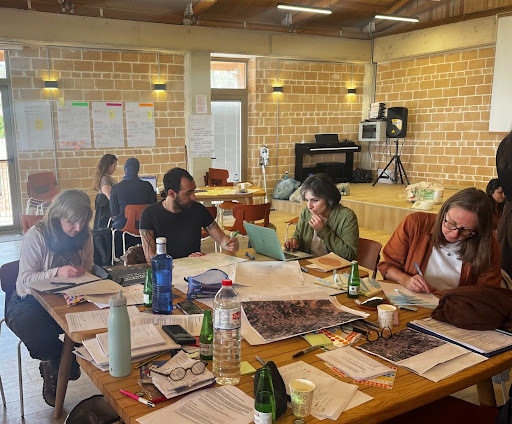
The Community scale team working to synthesise fieldwork data at the Samandağ Change by Design Workshop in April 2026 (Credits: Bonnie Greer)
Yildiz et al. (2024) call traditional ecological knowledge the epitome of sustainable development, as these systems work within the limits of local ecological capacity. Displacement, and the severing of community bonds to local environment and knowledge systems, therefore threatens not only to the justice dimension of just urban transitions but also to their sustainability aims. I came to see displacement as a form of “de-worlding” (Escobar, 2018): the unravelling of a community's ways of life, relationships and practices, extending well beyond the loss of homes.
Through primary research and ASF–UK’s published reports, I explored how Traditional Ecological Knowledge is embedded in communities’ relationships with their homelands and agricultural practices, which are core to their identities. This is reflected in different forms of ethics, knowledge and practice: in residents' collective action to protect orchards from bulldozers; in the celebration of harvest festivals; in long-term observations of environmental change and knowledge of ritual and medicinal herbs; and in practices such as olive harvesting, soap production and traditional building. These examples offer starting points for exploring how Traditional Ecological Knowledge and locally grounded practices can inform just urban transitions in the context of post-earthquake Antakya and Samandağ.
By analysing ASF–UK’s research through the JUT framework, I found that it primarily focuses on communities’ connections to the urban environment (social-technological), with comparatively less attention to their relationships with the natural environment (social-ecological). ASF–UK’s reports often discuss environmental relationships in relation to the built environment or public health. This suggests an opportunity to bring social-ecological relationships more explicitly into the research findings and key takeaways.
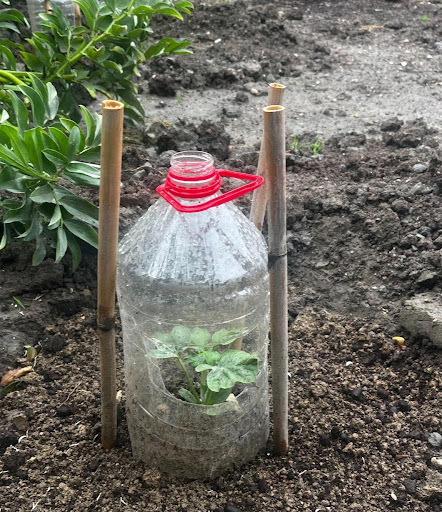
Image of residents' home garden from fieldwork in Samandağ which includes a plant growing within a reused plastic bottle (Credits: Bonnie Greer)
ASF–UK’s research and advocacy already contribute to resistance by documenting community needs, struggles and hopes throughout reconstruction. However, a TEK-focused approach could strengthen this work by making more visible the relationships with land, water and ecosystems that sustain community life. Cases from across the world, including Türkiye, illustrated how TEK operates across each of JUT’s three couplings. In this way, TEK broadens the understanding of justice within urban transitions, highlighting how displacement threatens not only housing but also the ecological relationships and livelihoods on which community life depends.
TEK is not a quick fix. Much of it is tacit and passed on orally, meaning that a few interviews cannot capture its depth, and its documentation also depends on knowledge holders being willing and able to share it. In a multi-ethnic region like Antakya and Samandağ, whose knowledge is recognised and represented is an open question. Documentation itself carries risks: recording community knowledge and makin their environmental assets visible could expose them to appropriation or exploitation, particularly given communities’ longstanding marginalisation by the state.
This is important for practitioners as it shows how large-scale development frameworks like JUT can be strengthened through locally grounded knowledge systems passed down through generations. By connecting with existing or revitalising past practices, ethics and knowledge, TEK has the potential to co-create solutions rooted in place, people and culture. The key is to position knowledge holders as experts on an equal footing with built environment practitioners, through long-term partnerships in research and decision-making, to avoid tokenism and shallow engagement.
Additionally, while development-induced displacement is on the rise internationally, it is important to recognise and support people's existing relationships with their built and natural environments, as displacement takes more than homes. It can also separate communities from the land, water and ecosystems through which generations of ecological knowledge have been sustained. And while integrating TEK-focused research within ASF–UK's work won't stop the bulldozers in Samandağ, where the government has shown little interest in community input, it can make the case for recognising these relationships harder to ignore. So the question I'd leave with practitioners is this: when you document living heritage, are you capturing the land, water and plants too, and the knowledge of the people who tend them?
Berkes, F. (1999) Sacred Ecology. 3rd ed. New York: Routledge. Available at: https://doi.org/10.4324/9780203123843.
Dávila, P., Langlois, G. and Leitão, R. (2023) “Introduction: Making Worlds in the Pluriverse,” Public, 34(68), pp. 5–6. Available at: https://doi.org/10.1386/public_00157_1.
Escobar, A. (2018) Designs for the Pluriverse: Radical Interdependence, Autonomy, and the Making of Worlds. Duke University Press. Available at: https://www.jstor.org/stable/j.ctv11smgs6 (Accessed: September 15, 2026).
Hughes, S. and Hoffmann, M. (2020) “Just urban transitions: Toward a research agenda,” WIREs Climate Change, 11(3), p. e640. Available at: https://doi.org/10.1002/wcc.640.
Martin, J.F. et al. (2010) “Traditional Ecological Knowledge (TEK): Ideas, inspiration, and designs for ecological engineering,” Ecological Engineering, 36(7), pp. 839–849. Available at: https://doi.org/10.1016/j.ecoleng.2010.04.001.
Osterlund, P.B. (2024) Turkey’s Reserve Areas, The Dial. Available at: https://www.thedial.world/articles/news/issue-14/turkey-earthquake-proof-housing (Accessed: August 25, 2026).
Pasta, F., Johnson, C. and Can, Ş. (2025) “Living heritage as shared knowledge: advancing community-led reconstruction in post-earthquake Antakya,” Environment & Urbanization, 37(2), pp. 440–464. Available at: https://doi.org/10.1177/09562478251365120.
Architecture Sans Frontières UK & Hatay Deprem Dayanışması (2024). Repairing Living Heritage in Çekmece: Pathways towards Community-led Reconstruction. London: ASF-UK. ISBN: 978-1-0685485-0-5 Available at: https://www.asf-uk.org/pages/reviving-living-heritage-in-antakya (Accessed: August 26, 2026).
Sun, Y. et al. (2025) “Understanding the dynamics of urban just transitions: An interdisciplinary analysis with latent dirichlet allocation (LDA),” Journal of Urban Management, 14(2), pp. 485–499. Available at: https://doi.org/10.1016/j.jum.2024.12.001.
Yildiz, D. et al. (2024) The role of traditional ecological knowledge in building sustainable infrastructure and housing in Pacific Island Countries. Available at: https://doi.org/10.13140/RG.2.2.33541.77286.
This article draws on research conducted by Bonnie Greer for the dissertation Beyond the Built Environment: Ecological Knowledge, Just Transitions and Resistance to Displacement in Antakya. The research was supported by ASF-UK through the Dissertation Fellowship Programme at The Bartlett Development Planning Unit (DPU), University College London.