After the Handover: What happens when an energy project is handed to the community living under it?
DPU/ASF-UK Fellow Megan Moulsdale asks what happens when a community takes control of a solar project, and who bears the costs.

By Megan Moulsdale
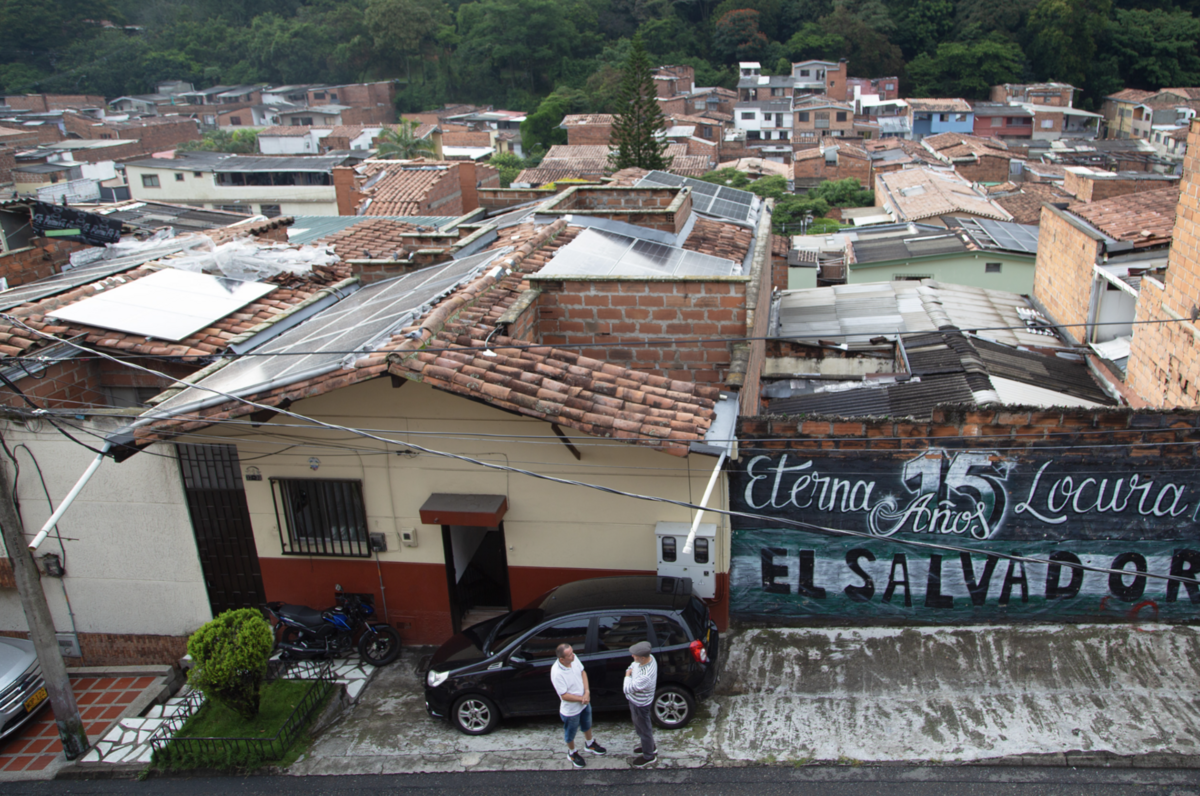
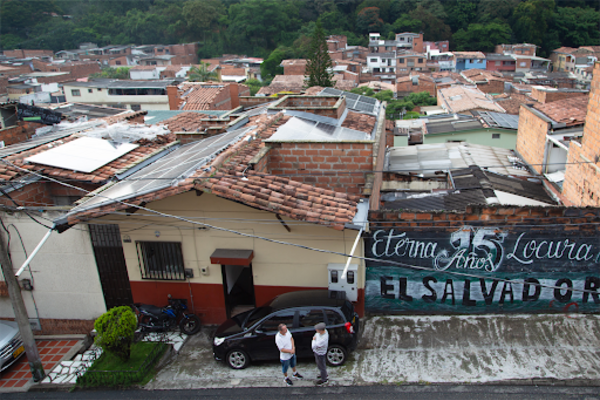
Solar panels on the roofs of houses in La Estrecha. (Credits: Diana Carolina Martínez López via Dialogue Earth)
La Estrecha is a steep street in El Salvador, a hillside neighbourhood in Medellín’s Buenos Aires district. In 2021, 24 households agreed to host solar panels on their roofs as part of a research pilot led by Universidad EIA, working with the city’s public utility, EPM, and private energy partners. The panels fed electricity into the national grid, and the income came back to residents as credit on their electricity bills.
La Estrecha was set up as what Colombia now calls an energy community: one shared system, owned and run by neighbours, selling energy to the grid together. It was the country’s first grid-connected one, and it arrived at the right political moment. Former President Gustavo Petro made energy communities central to his vision for a Just Energy Transition, promising to open up an energy system long dominated by large utilities, fossil fuels, and political elites to Colombians living in energy poverty.
In December 2023, the pilot phase of La Estrecha ended. The university and utility stepped back, and residents formed their own legal entity to take over the system. On paper, it was a clean transfer to an autonomous community. My MSc dissertation asked what changed when that happened. I focused on two things: participation (were residents invited into a process someone else controlled, or shaping it on their own terms?) and justice (who gets a say, whose knowledge counts, who bears the costs, and who benefits). These questions matter because a community can own a system without having real control over it.
Handovers are usually treated as the finish line. Once ownership transfers, institutions move on, and there is little research on what happens next. So, I reviewed project documents and interviewed community leaders, the university team and the utility to understand not just whether the system still worked, but who was keeping it working, and at what cost.
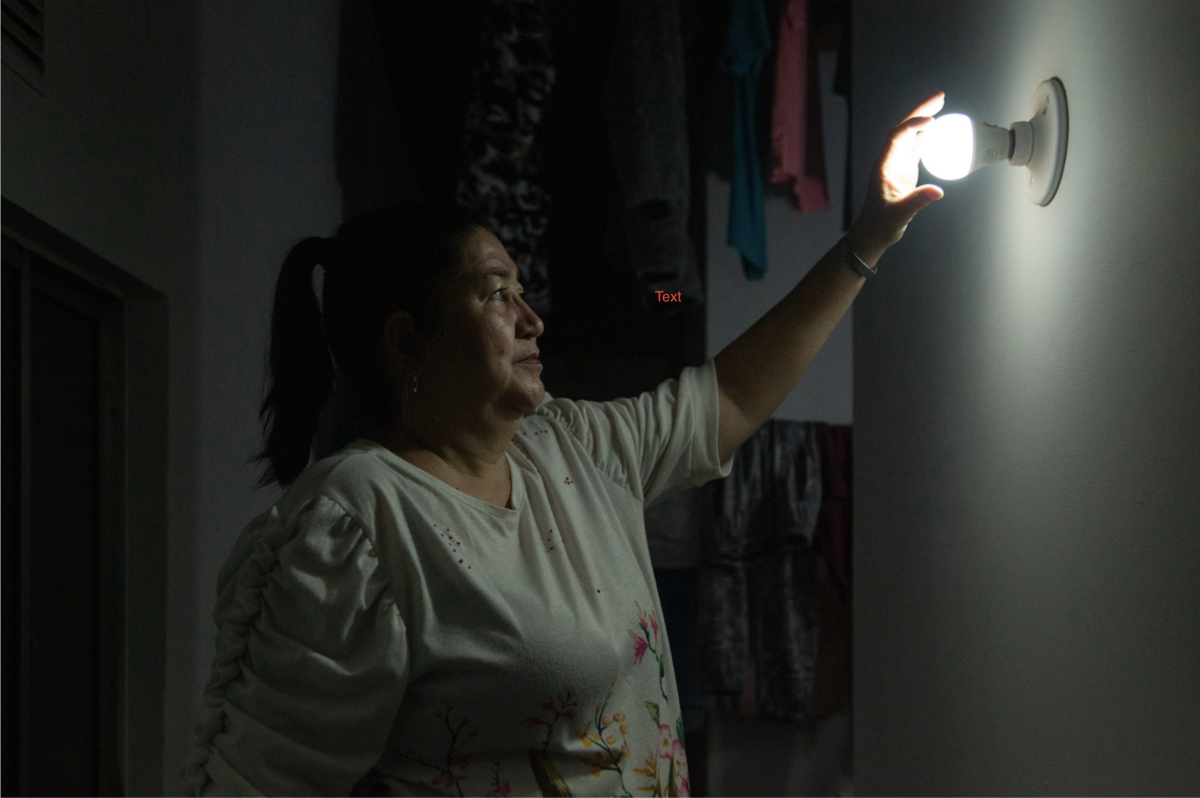
La Estrecha resident Beatriz Tamayo changes one of her home’s solar-powered light bulbs (Credits: Diana Carolina Martínez López via Dialogue Earth)
The handover came before the rules did. The regulator, CREG, didn’t issue rules on how energy communities connect to the grid and sell energy until April 2025, leaving La Estrecha in limbo for almost a year and a half. Until then, every kilowatt-hour was sold to EPM at the wholesale price, roughly 250–300 pesos (around 6–7p), and returned to residents as a bill discount. The new rules, however, let the community offset its generation directly against its own bills, at close to three times the old rate. When I carried out my interviews in July 2026, it was clear that many of La Estrecha’s remaining challenges stemmed from the delay in issuing the CREG framework.
The answer to my research questions is similarly messy. There has been a real shift, but whether it has produced genuinely autonomous participation and a better deal for residents is not clear-cut. Decisions now largely sit with the community, with residents making day-to-day choices by informal consensus. EPM and the university deserve credit here, as their workshops left residents confident explaining how the panels worked and what their bills meant, no small achievement for a technology new to almost everyone on the street.
But the capacity to run the system, and benefit from it, is not shared evenly. Technical knowledge is held by a few people, and the administration (paperwork, accounts, dealing with the utility) has fallen almost entirely on one resident who perceives it to be an unpaid burden, noting, “I manage the finances, organise them, and expedite them. I’d like it to work differently.” Leadership was never formally elected; another leader described roles going to whoever was willing, a system they called voluntacracia, or volunteer democracy. It works as long as those few people keep going, but there is no plan for if they stop.
The relationship with EPM is not one of equals either. Several participants told me they wait up to 90 days to be reimbursed for the energy they generate, a delay that is hard to shoulder in a lower-middle-class community, with little leverage against one of Latin America’s largest utilities.
Scaling the model to poorer communities is also questionable. Under Colombia’s estrato system, homes are classified from 1 to 6, and lower-income households receive heavily subsidised electricity, so solar offers them little saving. The result is a paradox: the households with the most to gain from a fairer energy system have the least financial reason to join one.
Colombia has more than 2,000 energy communities in the pipeline. But just as the regulation began to catch up, national politics shifted. Petro’s government set a target of 20,000 energy communities, later cut to 5,000; by the time it left office, only around 15 had been formally established. Abelardo de la Espriella, who took office in August 2026, promised to reverse much of Petro’s agenda alongside a “solar and wind revolution.” The question is not whether Colombia keeps building solar, but whether community ownership survives without the political sponsor that made La Estrecha a flagship. Given long payment delays and too few volunteers sharing the load, the model looks increasingly fragile.
For practitioners concerned with spatial justice, handovers need preparation with a broad cross-section of the community, but they cannot be the end goal. That could mean budgeting for paid administrative roles, training several residents rather than relying on a few, and setting firm deadlines for utilities to pay communities. Sharing burdens, holding utilities to account, dealing with unintended consequences, and scaling pilots all require ongoing external support, even once the community is in the driver’s seat. La Estrecha has earned its place as a Colombian energy-justice flagship, but between the regulatory delay, the abrupt policy shift, and unresolved internal burdens, its long-term impact remains in question.
This article draws on research conducted by Megan Moulsdale for the dissertation Reconocida pero no Autónoma: A Case Study of Governance and Justice in La Estrecha, Colombia's First Grid-Connected Energy Community. The research was supported by ASF-UK through the Dissertation Fellowship Programme at The Bartlett Development Planning Unit (DPU), University College London.